

Global Passport Index 2026: Europe Holds Its Ground as the World’s Mobility Gold Standard

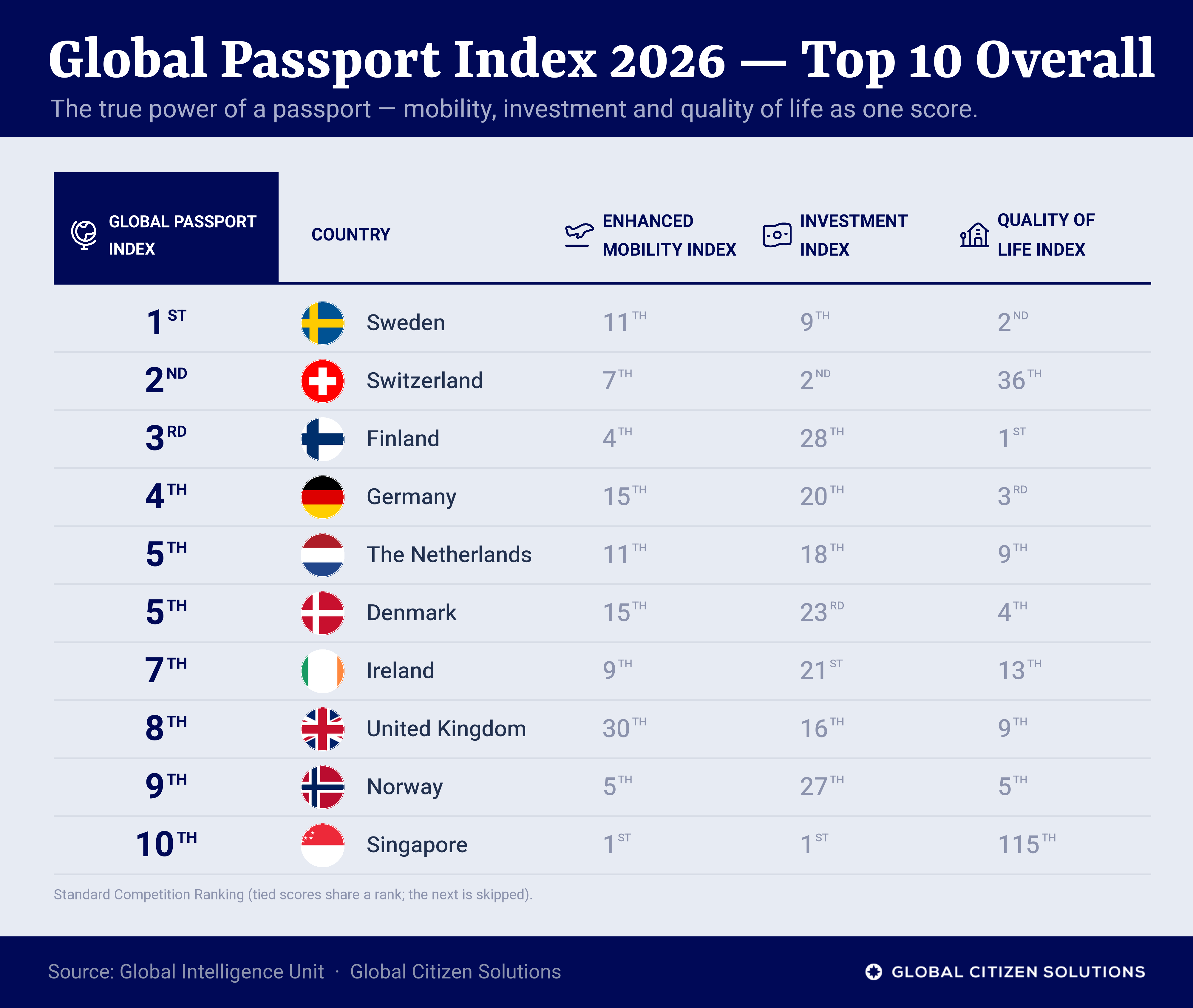
Top 10 passports globally
Nine of the world’s ten strongest passports are European with the Schengen Area’s expansion to 29 states reinforcing unmatched structural mobility
Europe’s edge: it is the only region that pairs near-maximum global access with the world’s highest quality of life, the one dimension no government can create through treaties or tax incentives.””
LONDON , UNITED KINGDOM, June 30, 2026 /EINPresswire.com/ -- Sub1: Nine of the world’s ten strongest passports belong to European states in the 2026 index, with the Schengen Area’s expansion to 29 states reinforcing a structural mobility premium that no other region matches— Patricia Casaburi, CEO, Global Citizen Solutions
Sub2: Sweden holds the top position for a third consecutive year, its lead built not on mobility alone — its mobility rank is only 14th — but on consistent strength across investment and quality of life
Sub3: The United States has fallen from 1st to 12th globally in five years — the steepest G7 decline in the index’s history — a decline with no equivalent among the European passports that dominate the top of the 2026 index
Sub4: Finland leads the world on quality of life, ahead of Sweden, Germany, Denmark, and Norway — a Nordic-Germanic cluster that has held the global top five with remarkable consistency across all five editions of the index
Sub5: Only 38.5% of the world’s bilateral relationships operate on a symmetric visa basis; Europe’s mobility advantage rests on a closed, mutually reinforcing network that most of the world’s population cannot access by birth
London — 30th June, 2026 — Global Citizen Solutions (“GCS”), a leading residency and citizenship planning advisory firm, today publishes the fifth annual edition of the Global Passport Index (GPI), the firm’s flagship research product ranking passports across 199 countries on mobility access, investment attractiveness, and quality of life. The 2026 edition confirms what the index has shown in every prior year: Europe remains the world’s mobility gold standard, and the gap between the European passport-holder and the rest of the world is not closing.
The GPI measures passport strength across three dimensions: mobility access (the number of countries reachable without a prior visa), investment attractiveness (tax environment, innovation, and economic competitiveness), and quality of life (healthcare, safety, climate, and social infrastructure). The composite score that results from these three pillars captures not just where holders can travel, but the full value of the country that stands behind their document. Europe is the only region in the 2026 index with a positive five-year trajectory across the board, and it hosts nine of the global top ten passports.
Nine of ten: the European cluster at the top
The 2026 top ten is overwhelmingly European: nine of the ten places belong to European states, led by Sweden, Switzerland, and Finland, with Singapore (10th) the sole non-European entry. The band itself is remarkably narrow — from Sweden’s 96.05 down to Singapore’s 92.80, a spread of barely three points — reflecting the degree of convergence among wealthy European democracies on mobility access, economic competitiveness, and quality of life. No other region in the 2026 index matches this concentration of high-scoring passports.
The structural driver behind Europe’s dominance is the Schengen Area itself. Its expansion to 29 states has built a mobility premium that no bilateral negotiation elsewhere in the world has been able to replicate at scale: a single European passport unlocks near-total freedom of movement across a bloc of nearly 30 countries, with no equivalent multilateral structure existing on any other continent. Where the UAE and the Gulf states have shown that mobility gains can be built rapidly through individual bilateral diplomacy, the European model demonstrates the alternative path: durable, structural advantage built into a single multilateral framework.
“The United Kingdom passport held firm in the global top ten throughout the period, ranked 8th overall in 2026, anchored by a quality-of-life score that sits among the world’s very best. Yet for a passport of such standing, its mobility rank is conspicuously modest, around 30th, well adrift of the elite tier it otherwise occupies. That gap is the quiet signature of Brexit. The index measures visa-free travel, where the British passport remains strong, but it cannot capture what was actually lost: the automatic right of UK citizens to live, work and settle across twenty-seven European states.”
— Patricia Casaburi, CEO, Global Citizen Solutions
Sweden: durability over headline mobility
Sweden has held the top position in the GPI for three consecutive years, rising from 6th place in 2021. What distinguishes Sweden’s ascent from a simple mobility story is that its mobility rank in 2026 is 14th, not 1st. The country’s dominance was built instead on consistent, reinforcing improvement across all three GPI dimensions: a quality of life rank of 2nd globally and an investment climate rank of 9th. Switzerland (2nd) and Finland (3rd) have followed a similar upward arc, both moving from outside the top ten in 2021 to lock in their current positions — evidence that the most durable composite passport strength in the index reflects genuine excellence in governance and quality of life, not mobility access alone.
Finland leads the quality-of-life pillar outright, ahead of Sweden, Germany, Denmark, and Norway — a Nordic-Germanic cluster that has held the global top five on this measure with remarkable consistency across all five editions of the index. Germany (4th overall) tells a more complex story: having led the composite index in 2022, it has since settled into fourth place, illustrating that even Europe’s strongest passports are not immune to relative movement within an otherwise stable regional bloc.
“Europe’s dominance of the Global Passport Index is total at the top, and it is built on balance, not on any single strength. The nine most powerful passports in the world in 2026 are all European, led by Sweden, Switzerland and Finland. What is striking is how they win. On pure travel freedom Singapore beats every one of them, and on raw investment pull several Gulf and Asian states rival them. Europe’s edge lies elsewhere: it is the only region that pairs near-maximum global access with the world’s highest quality of life, the one dimension no government can create through treaties or tax incentives.”
— Patricia Casaburi, CEO, Global Citizen Solutions
Eleanor LEGGE-BOURKE
Global Citizen Solutions
+351 934 336 384
eleanor@globalcitizensolutions.com
Visit us on social media:
LinkedIn
Legal Disclaimer:
EIN Presswire provides this news content "as is" without warranty of any kind. We do not accept any responsibility or liability for the accuracy, content, images, videos, licenses, completeness, legality, or reliability of the information contained in this article. If you have any complaints or copyright issues related to this article, kindly contact the author above.
