

Anomaly Detection Market Anticipated to Reach USD 15.4 Billion, Rising at 10.1% CAGR by 2035
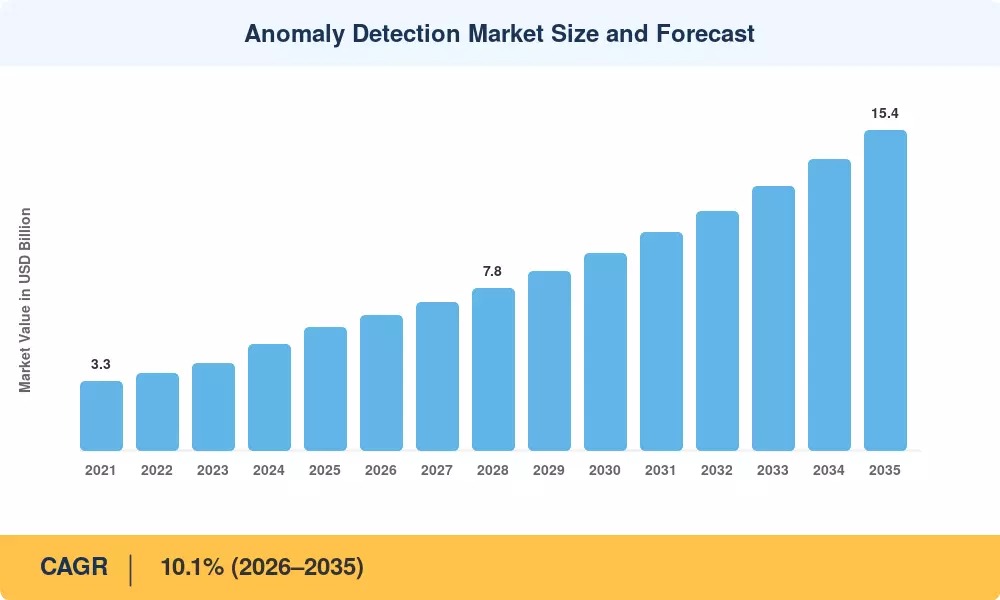
Anomaly Detection Market
Anomaly Detection Market grows with AI-powered analytics, enabling real-time fraud detection, cybersecurity, and predictive monitoring.
The Anomaly Detection Market is accelerating as AI-powered analytics transform fraud detection, cybersecurity, predictive maintenance, and real-time operational intelligence.”
PARIS, PARIS, FRANCE, August 7, 2026 /EINPresswire.com/ -- Anomaly detection has moved from a specialised IT security function to a core operational discipline, as organisations across finance, healthcare, and manufacturing lean on machine learning to spot unusual patterns before they become costly problems. Whether it is flagging a fraudulent transaction, an unusual spike in network traffic, or a subtle deviation in a production line, these systems increasingly run continuously in the background, scanning vast volumes of data in real time rather than waiting for a scheduled audit to catch what has already gone wrong.— Market Research Future
The global Anomaly Detection Market was valued at approximately USD 3.24 Billion in 2024 and is projected to grow from about USD 5.9 Billion in 2025 to roughly USD 15.4 Billion by 2035, reflecting a CAGR of 10.1% across the forecast period. Rising cybersecurity threats are a central catalyst, as the escalating frequency and sophistication of cyberattacks push organisations to adopt anomaly detection as a proactive line of defence rather than a reactive afterthought. Stringent regulatory frameworks, including Europe's data protection rules, are compelling industries such as finance, healthcare, and telecommunications to adopt continuous monitoring solutions capable of real-time reporting.
The integration of AI and machine learning is fundamentally reshaping detection capability, with increasingly sophisticated algorithms identifying complex patterns across massive datasets while reducing the false positives that have historically burdened security teams. Cloud-based deployment currently dominates the market, prized for its flexibility and its ability to integrate seamlessly across diverse IT environments, though many enterprises are migrating toward hybrid models that combine on-premises control with cloud-based scalability.
Get a Sample PDF of the Report at -- https://www.marketresearchfuture.com/sample_request/5756
Market Dynamics: Drivers, Restraints and Opportunities
Rising cybersecurity threats remain the single strongest driver of the Anomaly Detection Market, as cybercrime costs continue climbing into the trillions of dollars annually and organizations shift decisively toward proactive security postures. Anomaly detection technologies capable of identifying unusual patterns in network traffic have become essential tools for security teams racing to stay ahead of increasingly sophisticated attackers. The rapid proliferation of connected IoT devices compounds this need, as the exponential growth in data streams from interconnected sensors creates monitoring challenges that only automated anomaly detection can realistically address at scale, with irregularities in device data streams often signaling potential failures or security breaches long before they become visible through conventional monitoring.
Regulatory compliance requirements are pushing adoption further still, as finance, healthcare, and telecommunications organizations face mandates requiring continuous transaction and activity monitoring to prevent fraud and preserve data integrity. Growing demand for predictive analytics is reinforcing this trend, since identifying outliers within datasets is foundational to reliable forecasting, and organizations striving to become more data-driven are increasingly weaving anomaly detection directly into their broader analytics frameworks. Continued advancement in machine learning algorithms is improving detection precision and cutting false positives, making these systems more practical and cost-effective to operate at enterprise scale.
Even with this tailwind, the market faces real constraints. Legacy on-premises systems, while valued for data control, often struggle to keep pace with the real-time analytical demands that modern anomaly detection requires, creating friction during migration to more capable architectures. Smaller organizations frequently lack the specialized machine learning expertise needed to properly tune and maintain these systems, and the risk of false positives, if not carefully managed, can erode user trust and lead to alert fatigue among security and operations teams. Integrating new anomaly detection tools with existing legacy infrastructure, particularly older SIEM and SOAR platforms, remains a persistent technical and budgetary hurdle for many enterprises.
These constraints are also opening meaningful opportunities. Integrating anomaly detection directly into IoT device ecosystems for predictive maintenance represents a substantial growth avenue, as manufacturers and industrial operators seek to catch equipment failures before they cause costly downtime. Industry-specific solutions tailored to the particular data patterns and compliance needs of finance and healthcare are gaining traction over generic, one-size-fits-all platforms. The expansion of cloud-based anomaly detection services priced and packaged for small and medium enterprises is opening a large underserved segment of the market, while healthcare analytics is emerging as a genuinely promising frontier as providers increasingly use anomaly detection to catch unusual patterns in patient data that could signal safety risks or care-quality issues.
Key Players and Competitive Insights
The Anomaly Detection Market features a dynamic mix of established technology providers and emerging startups, with competition centered on technological innovation, customer service quality, solution scalability, and adaptability across diverse industry needs. Companies increasingly differentiate through the breadth of applications they can address, spanning fraud detection, network security, industrial monitoring, and IT operations.
Prominent players in the global Anomaly Detection Market include IBM, Microsoft, SAS, Splunk, DataRobot, H2O.ai, Anodot, AWS, and Google, alongside specialists such as LogRhythm. LogRhythm has built a strong reputation around security intelligence, integrating advanced analytics with machine learning to spot unusual patterns in real time, backed by continuous R&D investment and a strong focus on customer engagement.
AWS has established a significant cloud-native presence through services like Amazon GuardDuty for continuous threat detection and Amazon Macie for data security, leveraging its broad cloud infrastructure, scalability, and cost-effectiveness to serve businesses of every size. IBM has bolstered its AI-driven anomaly detection capabilities through targeted acquisitions, while Microsoft and Splunk continue to expand their offerings, with Microsoft placing particular emphasis on hybrid cloud solutions.
Buy this Premium Research Report at - https://www.marketresearchfuture.com/checkout?currency=one_user-USD&report_id=5756
Market Segmentations
By Application
● Fraud Detection
● Network Security
● Industrial Monitoring
● IT Operations
● Healthcare Analytics
By Deployment Mode
● Cloud
● On-Premises
● Hybrid
By Component
● Software
● Services
By End Use
● BFSI
● Retail
● IT and Telecom
● Healthcare
● Manufacturing
By Region
● North America
● Europe
● Asia-Pacific
● South America
● Middle East & Africa
Regional Insights
North America leads the Anomaly Detection Market, with a 2024 valuation of roughly USD 0.93 Billion, reflecting the region's heavy investment in technology and research and development along with its dense concentration of leading cybersecurity vendors. Europe follows closely at approximately USD 0.71 Billion in 2024, propelled by stringent regulatory requirements that compel organizations across sectors to adopt continuous monitoring solutions. Together, North America and Europe are expected to retain the majority of global market share through 2035, underpinned by their established industrial bases and sustained focus on advanced cybersecurity.
Asia-Pacific, valued at around USD 0.67 Billion in 2024, is gaining ground quickly as digital transformation and data analytics adoption accelerate across emerging economies in the region. South America and the Middle East & Africa remain comparatively smaller markets, valued at approximately USD 0.22 Billion and USD 0.36 Billion respectively in 2024, but both are positioned for meaningful expansion as awareness of anomaly detection's value and the underlying technological infrastructure continue to mature.
Browse A Full Report: (Including Full TOC, List Of Tables & Figures, and Chart) -- https://www.marketresearchfuture.com/reports/anomaly-detection-market-5756
Recent Developments
Vendors have been racing to sharpen their anomaly detection capabilities as cybersecurity and data integrity climb the priority list for enterprises. CrowdStrike announced an enhancement to its Falcon platform incorporating advanced anomaly detection capabilities aimed at improving threat identification, while LogRhythm integrated new machine learning models into its Security Information and Event Management system to deliver more accurate real-time detection. Rapid7 reported a substantial rise in demand for its anomaly detection services, reflecting the sector's broader upward trajectory.
IBM completed the acquisition of a smaller cybersecurity firm to strengthen its AI-driven anomaly detection methodologies and sharpen its competitive position, while Microsoft and Splunk have continued expanding their offerings and client services, with Microsoft placing particular focus on hybrid cloud solutions. The pace of investment and consolidation across the sector reflects how quickly organisations are adapting to new security challenges and seeking more effective tools for threat management and data breach prevention.
Frequently Asked Questions (FAQs)
Q1. What is the expected growth of the Anomaly Detection Market?
The market is projected to grow at a CAGR of 12.48% from 2025 to 2035, reaching about USD 11.81 Billion by 2035.
Q2. What factors are driving the Anomaly Detection Market?
Rising cybersecurity threats, IoT device proliferation, regulatory compliance requirements, and growing demand for predictive analytics are key growth drivers.
Q3. Which region dominates the Anomaly Detection Market?
North America currently leads with a 2024 valuation of roughly USD 0.93 Billion, supported by heavy technology investment and R&D.
Q4. What are the major challenges facing the market?
Legacy system integration, a shortage of specialized machine learning expertise, and the risk of false positives eroding user trust remain key challenges.
Q5. Which application segment holds the largest market share?
Fraud Detection currently leads the market, while Network Security is the fastest-growing application segment.
Q6. Who are the leading companies in the Anomaly Detection Market?
Major players include IBM, Microsoft, SAS, Splunk, DataRobot, H2O.ai, Anodot, AWS, and Google.
Q7. Which deployment mode is most widely used?
Cloud deployment currently leads the market, valued for its flexibility and scalability, while hybrid models are gaining ground quickly.
➤➤ Latest Market Intelligence from Market Research Future:
Safety Critical Software Testing Market-
https://www.marketresearchfuture.com/reports/safety-critical-software-testing-market-7456
Virtual Private Server Market-
https://www.marketresearchfuture.com/reports/virtual-private-server-market-7753
Real Time Location System Market-
https://www.marketresearchfuture.com/reports/real-time-location-system-market-8046
Online Meeting Software Market-
https://www.marketresearchfuture.com/reports/online-meeting-software-market-8297
School Management System Market-
https://www.marketresearchfuture.com/reports/school-management-system-market-8398
Hmi Software Market-
https://www.marketresearchfuture.com/reports/hmi-software-market-8653
Queue Management System Market-
https://www.marketresearchfuture.com/reports/queue-management-system-market-8692
Self-Service Technology Market-
https://www.marketresearchfuture.com/reports/self-service-technologies-market-927
Laser Technology Market-
https://www.marketresearchfuture.com/reports/laser-technology-market-5109
Neuromarket-
https://www.marketresearchfuture.com/reports/neuromarketing-technology-market-5340
Wearable Security Device Market-
https://www.marketresearchfuture.com/reports/wearable-security-device-market-5719
Rugged Handheld Devices Market-
https://www.marketresearchfuture.com/reports/rugged-handheld-devices-market-8047
Digital Content Market-
https://www.marketresearchfuture.com/reports/digital-content-market-11516
Webtoons Market-
https://www.marketresearchfuture.com/reports/webtoons-market-12024
Sagar Kadam
Market Research Future
+ +1 628-258-0071
email us here
Legal Disclaimer:
EIN Presswire provides this news content "as is" without warranty of any kind. We do not accept any responsibility or liability for the accuracy, content, images, videos, licenses, completeness, legality, or reliability of the information contained in this article. If you have any complaints or copyright issues related to this article, kindly contact the author above.
