

New 2024 Seattle Greenhouse Gas Inventory Shows a Decline in Climate Pollution as Seattle Grows
Today, we released Seattle’s 2024 greenhouse gas (GHG) emissions inventory. The findings show core emissions decreased approximately 6% from 2022. The buildings sector saw a decline in emissions, while transportation remained the largest emissions source and was relatively flat. Population increased 4% and economic activity rose 11% during that same period.
Overall, emissions have declined 18% from the 2008 baseline, while population increased 32% and regional economic activity nearly doubled at 94%. Since then, about 83% of new homes were built in compact, walkable, and transit-connected neighborhoods, and driving per resident has fallen 28%.
“Seattle has grown fast, and the greenhouse gas inventory shows that since 2008 we have added homes and jobs and moved more people and goods while bringing climate pollution down,” said Mayor Katie Wilson. At the same time, the data show we need to move much faster. Seattle will continue to work with our local, regional, and state partners to speed up climate solutions that strengthen our city while attracting businesses and keeping our communities healthy. Affordable and abundant housing and irresistibly good public transit — both high priorities for my administration — are climate solutions. Through Seattle’s upcoming Climate Action Plan, we will expand clean transportation options, modernize buildings, and create great public spaces for people to gather.”

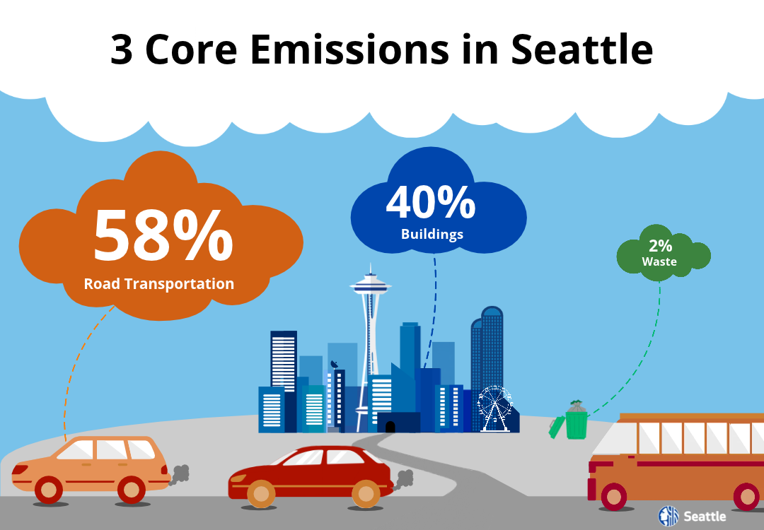
Seattle conducts GHG inventories biennially (every two years). The key findings below cover three core sectors: Transportation, buildings, and waste.
- Transportation (56% of core emissions): 1% increase in GHG emissions. Seattleites are driving substantially less than they did in 2022, with a 10% reduction in vehicle miles traveled. Transit ridership has continued to recover post-pandemic, with Metro reporting strong growth in weekday bus ridership and Link light-rail ridership increasing by nearly 6.3 million boardings. Electric vehicles increased from 5.6% to 7.6% of miles driven. Emissions from increased freight activity offset most of these positive shifts.
- Buildings (41% of core emissions): 14% decrease in GHG emissions. Residential building emissions decreased 24% and commercial emissions declined 18% from 2022, largely as a result of a spike in fossil gas consumption in 2022. Milder weather partially contributed to lower energy use in 2024, with about 6% fewer heating degree days and 17% fewer cooling degree days. Fossil gas continues to produce most building emissions, despite electricity supplying more than half of total building energy use.
- Waste (3% of core emissions): 7% increase in GHG emissions. The increase was driven primarily by higher amounts of commercial waste, as well as changes in types of materials discarded. Residential and self-haul waste emissions remained comparatively stable.
Total core emissions decreased as Seattle continued to grow. At the same time, Seattle, like many cities, is not on track to meet its climate goals. The City needs to move nine times faster to meet its goal of reducing emissions 58% below 2008 levels by 2030. OSE is leading the development of Seattle’s Climate Action Plan update, a five-year plan for the City to accelerate emissions reduction and prepare for climate impacts. The 2013 Climate Action Plan Progress Report assesses the City’s progress in implementing the 2013 plan.
In recent years, the City has implemented and expanded several policies, programs, and investments to reduce emissions.
Seattle’s Building Emissions Performance Standard (BEPS) is projected to cut emissions roughly 12% by 2050 through a single policy and will have its initial reporting year in 2027 ahead of the first emissions target in 2031. Data for Seattle’s BEPS and residential Clean Heat Program are not yet reflected in this inventory but are projected to reduce building emissions a combined 35% by 2050. OSE and Capital departments are also making progress toward cutting emissions from all City-owned buildings by 2042. The proposed 2026 Library Levy includes $34 million for heating and cooling upgrades. You can track energy and emissions use in City buildings through the Municipal Building Decarbonization Dashboard or view OSE’s Climate Planning & Data web page.
“Climate change impacts all of us. We each have an important role to play in protecting the health of our communities and our planet,” OSE Director Lylianna Allala said. “The data shows that we need to move faster, and the time is now. I am proud that the Office of Sustainability and Environment is leading the development of the Climate Action Plan that will put Seattle on an accelerated path for action. We’re collaborating with hundreds of partners with diverse expertise and lived experiences to develop bold strategies together. At the same time, we’re continuing to invest in clean‑energy careers, climate upgrades for community-serving buildings, and community-led projects to ensure Seattle is making progress responsibly.”
The Seattle Department of Transportation (SDOT) is reducing emissions by adding infrastructure to increase walking, biking, and transit, at the same time as electrifying vehicles for people, goods, and services. Through implementing the voter‑approved $1.55 billion transportation levy, SDOT is piloting Low-Pollution Neighborhoods, installing more public electric vehicle chargers, expanding the tree canopy, and addressing emissions from freight by ramping up electric delivery options.
“Transportation is Seattle’s largest source of climate pollution, and we have an important role to play in helping people get around in cleaner, more sustainable ways,” said SDOT Acting Director Angela Brady, PE. “Through the voter-approved Seattle Transportation Levy, we’re investing in safer and more connected walking and biking networks, improving transit corridors like Route 8 on Denny Way, and expanding access to electric vehicle charging. These investments give people more options to get where they need to go while helping Seattle make progress toward its climate goals.”
Seattle Public Utilities (SPU) works to reduce waste and pollution by strengthening waste prevention programs such as reuse and salvage of building materials, stormwater pollution source control, and investing in community initiatives such as the Waste-Free Communities Matching Grant. Under Seattle’s Food Action Plan, SPU is expanding food waste prevention efforts through business outreach and Food Rescue Innovation, improving access to residential and commercial composting resources, and increasing opportunities to use reusable food service items across the city. These actions support local communities while reducing climate pollution and conserving resources.
“Seattle Public Utilities is encouraged by the progress our city has made to reduce climate pollution,” said Andrew Lee, SPU General Manager. “However, as the effects of climate change affect every aspect of our lives, from wildfires to lower snowpack and rising ocean temperatures, the need for citywide action to reduce carbon emissions is all the more critical at this time. It is imperative that we work with communities and expand the tools residents and businesses can use to reduce waste and carbon emissions at the source. I am proud of the partnerships that drive these efforts forward and SPU will continue to work to reduce waste in ways that make daily life healthier, sustainable, and more resilient to the impacts of climate change.”
Seattle’s updated Climate Action Plan will detail a set of bold, intersectional, and diverse actions. As 21 City departments contribute to the draft, several focus areas important to emissions reduction are emerging: clean and connected transit, climate-ready buildings, reuse and waste prevention, and climate adaptation.
Seattle City Light (SCL) has been carbon-neutral since 2005 and is essential to powering the clean energy transition. In recent years, SCL has significantly expanded programs that help customers transition to electric power in parts of life still running on fossil fuels, like transportation, heating, and cooling. This includes deploying more than 900 electric vehicle chargers, enabling residents and businesses to make the switch to electric, and partnering with King County Metro to help electrify public transportation in the region.
“We’re continually engaging with communities across our region to strengthen the grid, secure energy resources, and provide the right programming and support to our customers,” said Rob Santoff, SCL Interim General Manager and CEO. “We’re committed to meeting the increasing electricity demand with safe, reliable, affordable, and environmentally responsible energy services.”
The Climate Action Plan and other City planning efforts across land use, trees, transit, and community planning are key to sustainable growth while reducing emissions. Higher density around local transit, services, and amenities will reduce emissions from both transportation and buildings.
“For 30 years, Seattle has managed our population growth by concentrating density within our city’s Regional and Urban Centers,” said Rico Quirindongo, Director of the Office of Planning and Community Development. “Developing compact, complete, walkable neighborhoods reduces our reliance on automobile travel and lowers carbon emissions. Our newly updated Comprehensive Plan builds on this climate-friendly development strategy by continuing to focus population and employment growth within expanded Regional and Urban Centers and by adding 30 new Neighborhood Centers, small areas of density within neighborhoods across the city that have existing small commercial retail buildings and are near transit, parks, and schools. The plan also reflects and guides emissions-reduction and climate-resilience efforts across City departments. With this Climate Action Plan update, we have an opportunity to continue implementing policies that build on this foundation.”
The updated Climate Action Plan will be unique in that it is being shaped directly by community input, with a focus on residents with low incomes, people of color, outdoor workers, and other populations most affected by climate impacts like flooding, extreme heat, and pollution. Since last fall, OSE has organized roundtables and community conversations with Indigenous people and youth, convened a regional forum of more than 100 partners across diverse sectors, gathered feedback from over 1,200 residents through a public survey, and worked with community liaisons to collect insights from Chinese, Somali, Spanish, Tagalog, and Vietnamese communities.
OSE expects to release a draft of the Climate Action Plan for public comment this year and transmit it to City Council in early 2027. OSE has more engagements planned this year. You can view a summary of public engagement and community feedback on the plan online.
View all climate-related data that OSE tracks spanning emissions and energy use, municipal buildings, food policy, Seattle’s Duwamish Valley Program, and more on OSE’s Climate Planning & Data web page. The State Department of Ecology plans to publish its next annual statewide GHG inventory in December, and King County released its most recent report in November 2025.
Legal Disclaimer:
EIN Presswire provides this news content "as is" without warranty of any kind. We do not accept any responsibility or liability for the accuracy, content, images, videos, licenses, completeness, legality, or reliability of the information contained in this article. If you have any complaints or copyright issues related to this article, kindly contact the author above.
